









Almost every day when I wake up, I read a headline about a company investing millions or billions of dollars to somehow integrate AI into its workforce, and it’s largely because businesses do not want to miss out, even if they don’t fully understand what they’re missing out on. But Microsoft CEO Satya Nadella warns that if businesses rely on a single AI model, they may not “remain a firm.”
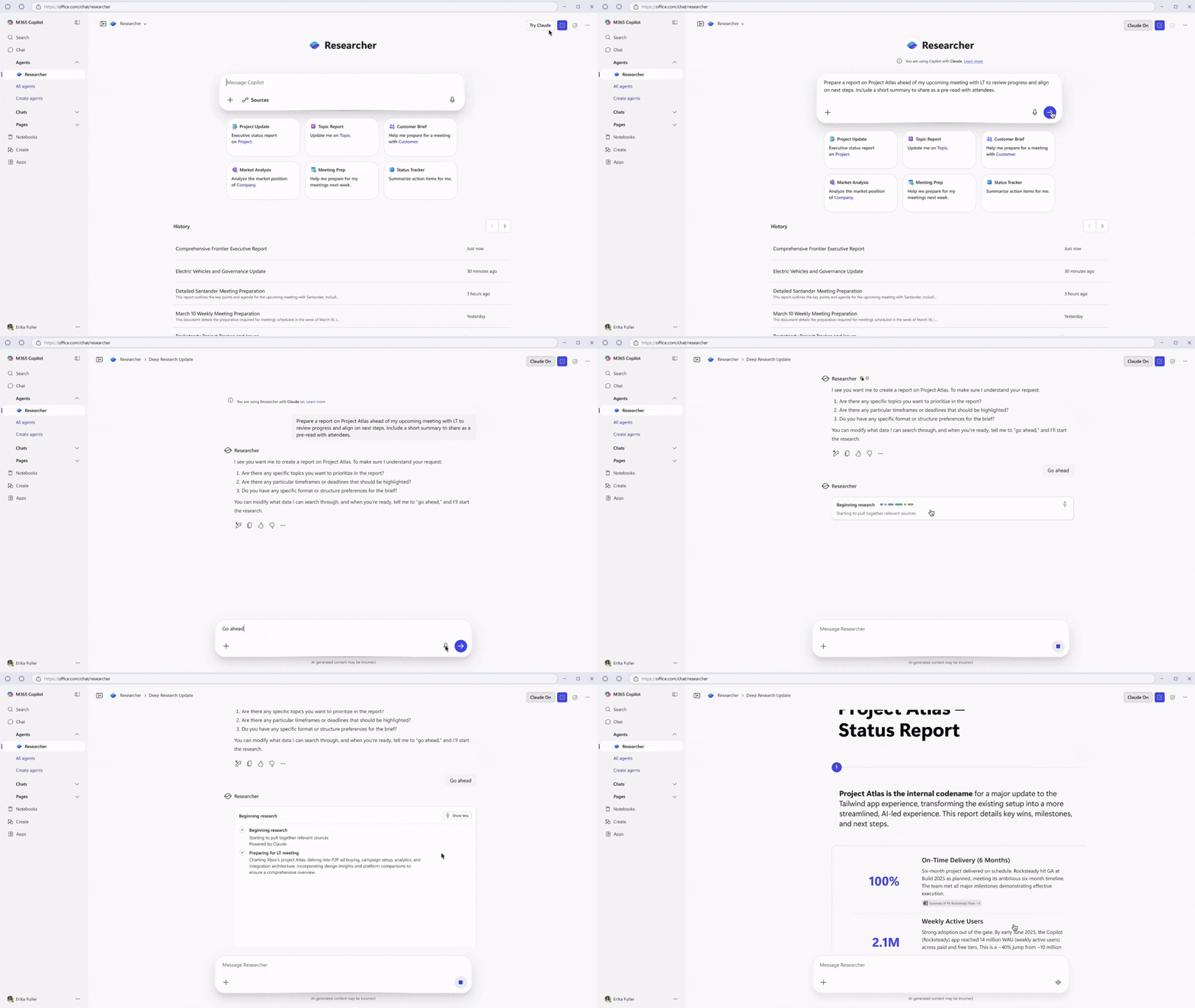
Unlike some of its competitors, Microsoft has taken a different approach where it allows businesses using Microsoft 365 Copilot to choose their preferred models, including OpenAI and Claude models. That probably explains why Satya Nadella recently argued that businesses should never become dependent on a single AI model.
In a podcast with CNN, journalist Fareed Zakaria argued that every time you use AI, you’re giving AI companies your data, and that data can include your knowledge, thought process, ideas, and vision.
“They’re essentially stealing that and making their models better,” Zakaria said, and it’s something most of us would probably understand the concern behind.
You can opt out of model training, but we also cannot blindly assume every AI company will always behave exactly as users expect. After all, companies have been accused of buying books, training models on them, and then destroying the physical copies, so the industry has already had plenty of ethical controversies.
Satya Nadella appears to agree with this belief.
“A hundred percent,” CEO Satya Nadella responded when asked whether companies and consumers should have control over this.
“My thesis is simple, which is if the firm has to exist, let’s leave consumer markets outside because to some degree, there’s got to be some value exchange in the consumer space where you’re getting something for free, maybe for your data,” Nadella said.
“That’s sort of how the advertising business model has worked. So let’s leave that aside.”
For businesses, though, Nadella says the rules need to be very different, or it could threaten the very existence of a firm. Ironically, these comments come as Microsoft continues pushing Microsoft 365 Copilot across its products, from Word and PowerPoint to Windows and OneDrive.
Nadella argues that consumers and companies approach AI very differently because a company creates its own knowledge, and that knowledge needs to remain with the company rather than becoming tied to an AI model or provider.
“I am a firm that creates knowledge, and I need that knowledge to stay inside the firm,” Nadella explained. “I not only have human capital, but now I’ll have increasing levels of token capital.”
By “token capital,” Nadella is referring to the knowledge a company builds up through its use of AI, including the context around prompts, interactions, and how employees use these models.
“Every time you use the model, all of the metadata around it is sort of retained by you so that you could use all of that to train perhaps your own weights or your own model,” Nadella said.
Nadella also doesn’t want businesses to become dependent on one AI model, and as I noted above, his argument is in line with the approach Microsoft is now taking with Copilot, where businesses can choose from Claude, OpenAI, and other models.
“Any one model can go away and you can still continue to be in sort of control of your own destiny,” Nadella said in a podcast on CNN. “Any firm that doesn’t have this control, I will claim, will not remain a firm because you’ve essentially outsourced your thinking.”
However, Nadella is not arguing that people should avoid AI entirely. He believes the future of work will have humans working alongside AI agents, rather than replacing human judgment completely.
“The fundamental unit of work is a human plus their agents,” Nadella said.
Nadella seems to care a lot less about consumers, who may also be giving away their data and “outsourcing” knowledge unknowingly. I mean, at the end of the day, if handing over data and knowledge to AI is a problem for a company, it’s hard to argue that the same concern completely disappears for a regular consumer.
Does Microsoft train its AI model on your data?
In Microsoft’s own words, no, and the company has stated that through Copilot apps and multiple support documents. However, you do have the option to provide some data for training.
For example, if you have the Copilot app installed, there are two unchecked toggles. The first is “Training on conversation activity,” and the second is “Training on voice conversations.”
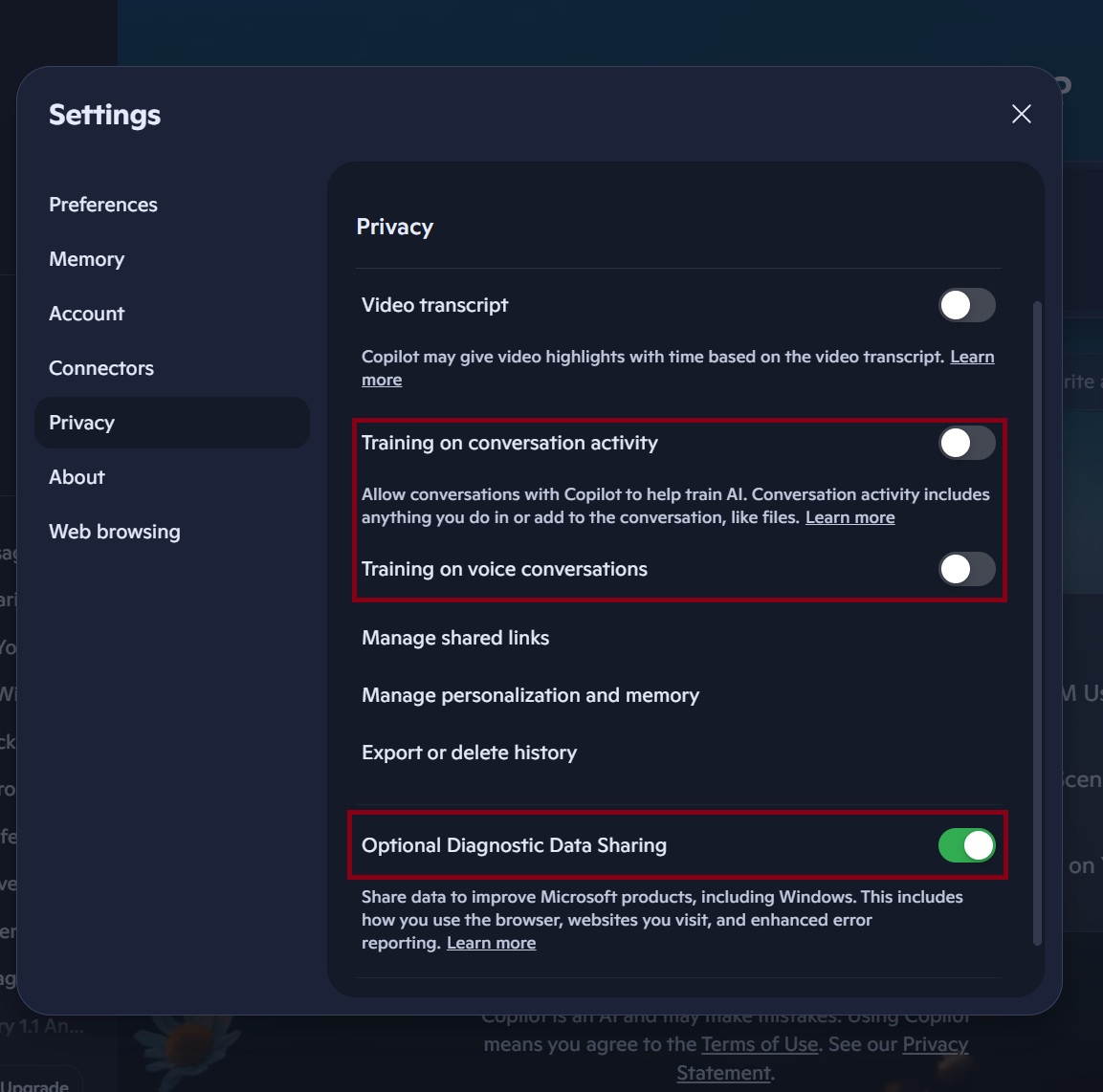
So, if you’re kind enough, you can allow “conversations with Copilot to help train AI,” including anything you add to the chat, such as your files and images.
However, those toggles are turned off by default, so it’s not exactly a worry.
But I recently spotted that there’s a third toggle called “Optional Diagnostic Data Sharing,” which is usually turned on by default. While it does not allow AI models to train on your personal data, it can share some data to “improve Microsoft products, including Windows.”
“This includes how you use the browser, websites you visit, and enhanced error reporting,” the toggle reads.
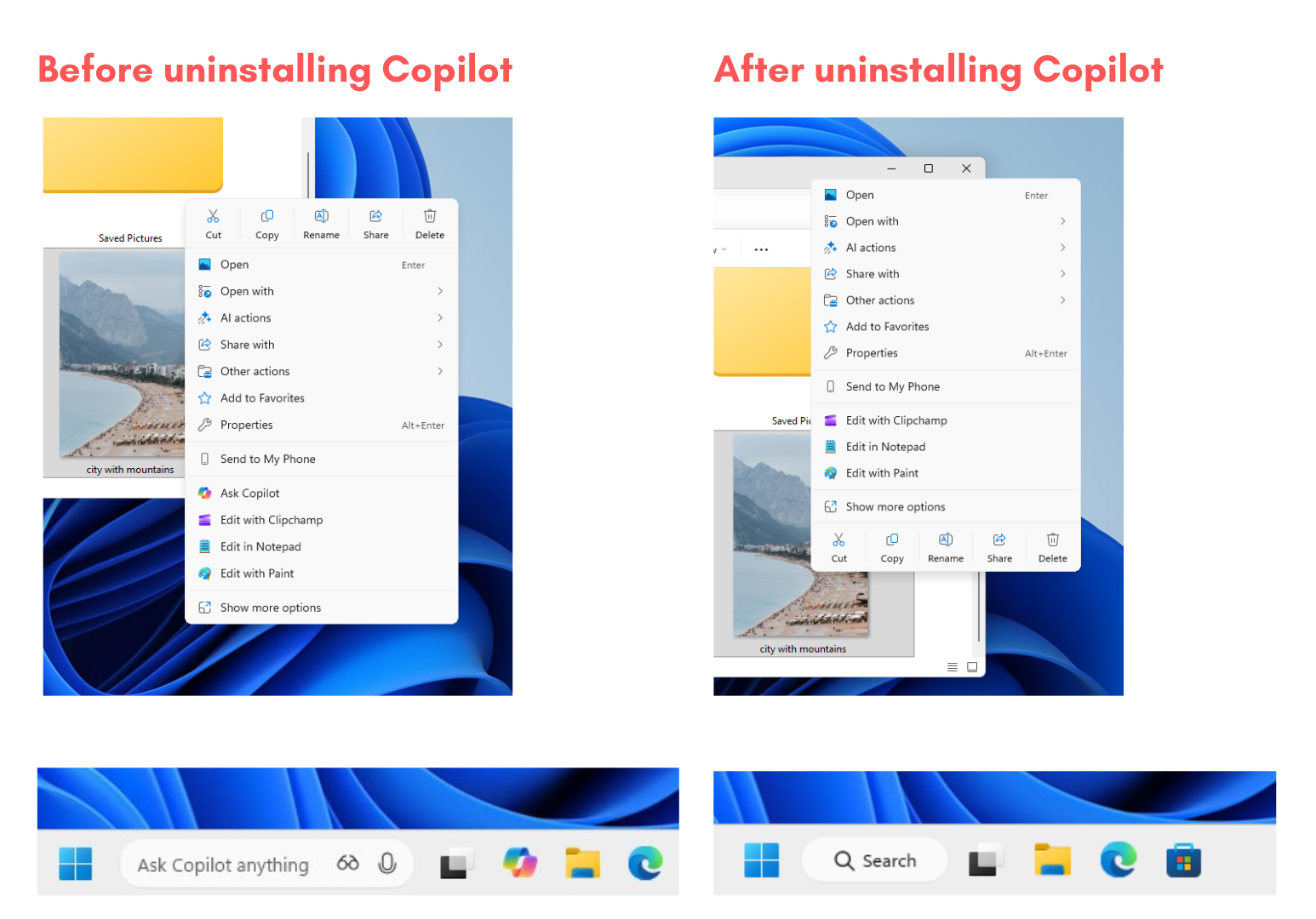
I haven’t been able to figure out why this toggle exists in Copilot for Windows, but if it’s turned on on your PC, make sure you disable it if you don’t want to share that diagnostic data. Or you can remove Copilot entirely if you don’t use the app at all.
In a document, Microsoft argues that AI models make predictions based on data, and to make that happen, they are trained on large amounts of information, including public data. Finally, the AI model “uses what it has learned to generate answers to questions or requests,” but Microsoft says it will not collect your personal data without your consent.
Do you agree that AI is “outsourcing your thinking,” and should companies like Microsoft stop enabling AI by default? Let me know in the comments below.