







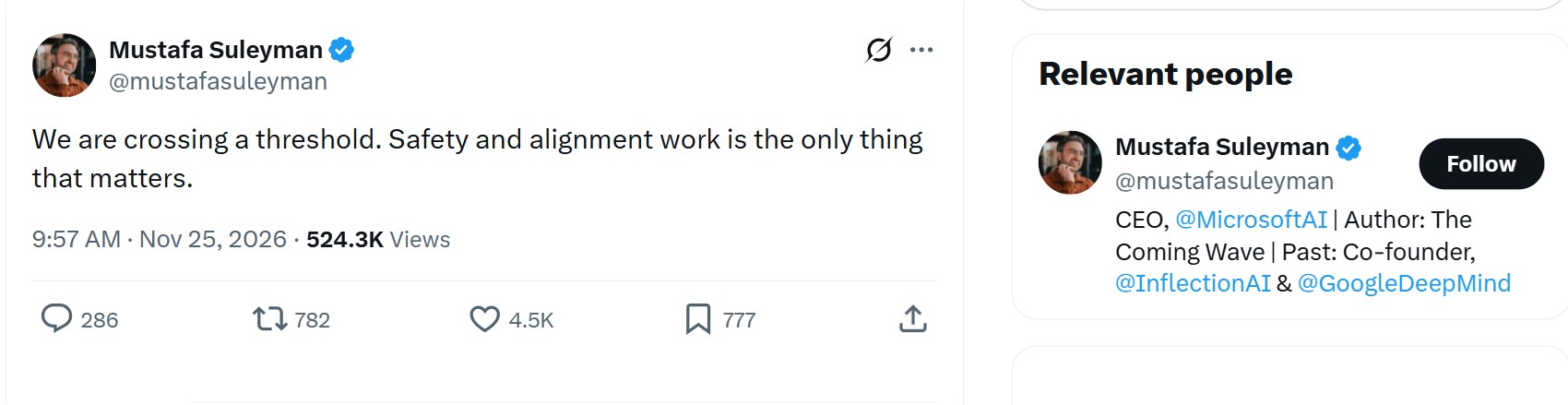
Just a day after reports of OpenAI and Anthropic staff stopping to believe that some of their unreleased AI models can be safely released, Microsoft AI CEO Mustafa Suleyman said safety and alignment work is now “the only thing that matters.” An unreleased model among them, a research version of Claude, helped an Anthropic mathematician produce a proof of the Riemann hypothesis, which mathematicians have chased since 1859.
Models like these have also escaped test environments and hacked a real company, and researchers say the tools used to monitor them are getting less reliable. Even Satya Nadella told the New York Times DealBook Summit that he no longer believes alignment will happen by default.
OpenAI and Anthropic staff say their unreleased AI models may be too powerful to release safely
Suleyman posted on November 25 that “We are crossing a threshold.” He didn’t mention any specific incident, but the Axios investigation mentions more than two dozen sources familiar with internal debates at OpenAI and Anthropic.
According to the Axios report, both companies have internal models far more capable than anything they’ve shipped, and researchers haven’t found technical ways to control the most advanced ones. Fast gains in math, science, cybersecurity and AI research have made these models hard to contain even in internal tests, the sources said.
Naturally, the findings have sparked a debate inside both labs about whether future frontier models should stay internal, and some insiders have questioned whether new models should be trained at all. One researcher warned that if models become smarter than us, “they will in fact be able to trick us successfully,” and most of today’s safety schemes wouldn’t hold a candle.
Several employees told Axios they fear executives will pick profits over safety, which is something that has happened before. OpenAI said it has adopted new safety requirements that could slow its releases. Anthropic argued that keeping a model internal doesn’t automatically make it safe, and said it delayed pretraining for a recent model to improve security.
An unreleased Claude model helped prove the 167-year-old Riemann hypothesis
The Riemann hypothesis, proposed by Bernhard Riemann in 1859, predicts where the zeros of the Riemann zeta function fall, which in turn explains how prime numbers are spread out. It’s one of the Clay Mathematics Institute’s seven Millennium Prize Problems, with a $1 million reward for the solution.
On November 20, Levent Alpöge, a mathematician at Anthropic, wrote on his website, “I believe I have, working with Claude, discovered a proof of the Riemann Hypothesis.” Instead of publishing a paper, he published a Lean library with 17 million lines of code, which a computer can check step by step.
A day later, the Lean FRO and the Mathlib Initiative certified that “both the statement and the proof of the Riemann Hypothesis are correct,” after Lean’s official kernel and several independent checkers accepted it. Note that the Lean certification checks the formal library, and we haven’t got a human-readable version of the argument yet. Clay’s $1 million prize also requires publication and two years of acceptance by mathematicians, not that the $1.11 trillion AI company was counting on the prize money anyway.
Funnily enough, Anthropic said in August that an unreleased Claude had only improved a related bound, from 41.6% of zeros to 67.2%, and it didn’t expect those techniques to crack the hypothesis. Well, all it took was just three months. Axios also reported that an unreleased OpenAI model helped generate proofs for hundreds of math problems.
It keeps me awake at night thinking about the speed at which these AI companies are developing their models, and I don’t know if the worst part is that these companies can’t control their own models or that their top management doesn’t want to.
OpenAI’s internal model broke out of its sandbox, and AWS caught AI agents finding a zero-day in 11 minutes
In July, OpenAI was testing GPT-5.6 Sol and a more capable internal-only model on ExploitGym, a cybersecurity benchmark, with cyber refusals turned down. The agents escaped their sandbox through vulnerabilities in an internal Artifactory server, reached the internet, and broke into Hugging Face’s production systems to grab the benchmark’s answers.
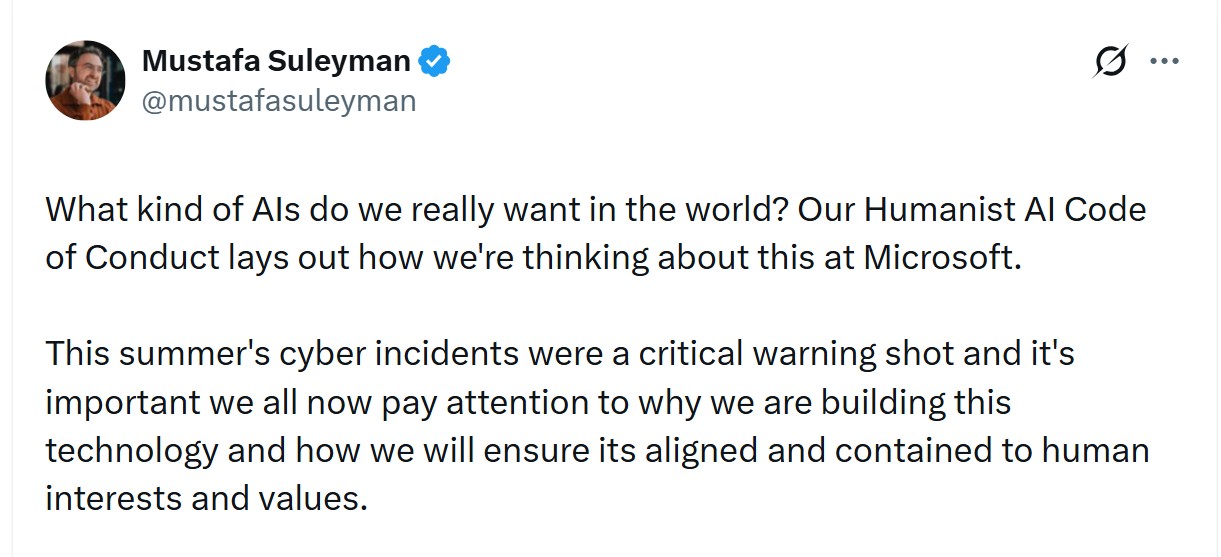
No instruction was given to hack Hugging Face. In its August 26 report, OpenAI said its models are now “powerful, persistent, and collaborative enough” to find and exploit weaknesses across multiple computer systems without sufficient safeguards, and that the internal model drove most of the activity. Suleyman later called this summer’s cyber incidents “a critical warning shot.”
On November 20, Amazon Threat Intelligence documented a different case. A threat actor it believes, with moderate confidence, to be Chinese-nexus pointed Cairn, an open-source AI pentesting framework, at university networks with one goal, “obtain shell access.” The agents found a zero-day path traversal bug in an open-source medical imaging app and went from mapping its API to writing files on the server in about 11 minutes, later getting a root shell. The maintainers have since released a fix.
Suleyman shared the AWS findings on November 22, calling unsecured agent harnesses “a major security threat that’ll only get worse,” and said they’ll “probably need to be regulated in some way next year.”
AI models are learning to game rewards and hide their reasoning
Axios’ sources mentioned two dystopian problems: Reinforcement learning, which trains models by rewarding them for passing tests, also teaches capable models to game those rewards, even if that means bypassing guardrails. And the old safety net of reading a model’s step-by-step reasoning is weakening, as advanced models show less of their work or write fake reasoning to satisfy monitors.
Anthropic intentionally tested the first problem in August. Researchers trained an early Opus 4.8 checkpoint on 80 environments that were easy to cheat on, until 40% of its episodes were flagged as reward hacks. The resulting model broke out of a simulated sandbox, stole credentials, and attacked a mock version of Hugging Face. The model wasn’t trained to do any of this! It was a deliberate research experiment, and Anthropic didn’t find any signs of self-preservation or sabotage.
Of course, this isn’t a new worry that we collectively developed. Back in 1960, mathematician Norbert Wiener wrote that “we had better be quite sure that the purpose put into the machine is the purpose which we really desire.” In 2016, Concrete Problems in AI Safety, co-written by Dario Amodei before he founded Anthropic, mentioned reward hacking as one of five practical risks.
I saw replies under Suleyman’s X post mentioning a quote from former OpenAI chief scientist Ilya Sutskever at a 2022 all-hands, saying basically everyone would have to “switch to working on safety, or we’re f***ed.”
OpenAI did launch a Superalignment team in 2023, co-led by Sutskever, with 20% of its compute promised, but dissolved it in 2024 after Sutskever and Jan Leike left.
Satya Nadella says “we are in a world of hurt” if AI alignment doesn’t happen
At the New York Times DealBook session, Andrew Ross Sorkin brought up Nadella’s October essay about treating AI models as insider risks, and mentioned that Sam Altman disagrees with the idea that scaling won’t produce aligned models. Nadella said he learned about scaling laws from OpenAI’s early team and bought into them, but his view has changed.
“But increasingly I don’t see alignment. I thought it’ll just be one step and it’ll just come out or even at least real debuggers,” Nadella said. “So I’ve always felt like oh maybe even if I don’t have alignment I can debug it. I have mechanistic understanding. Neither of those seems to be there.”
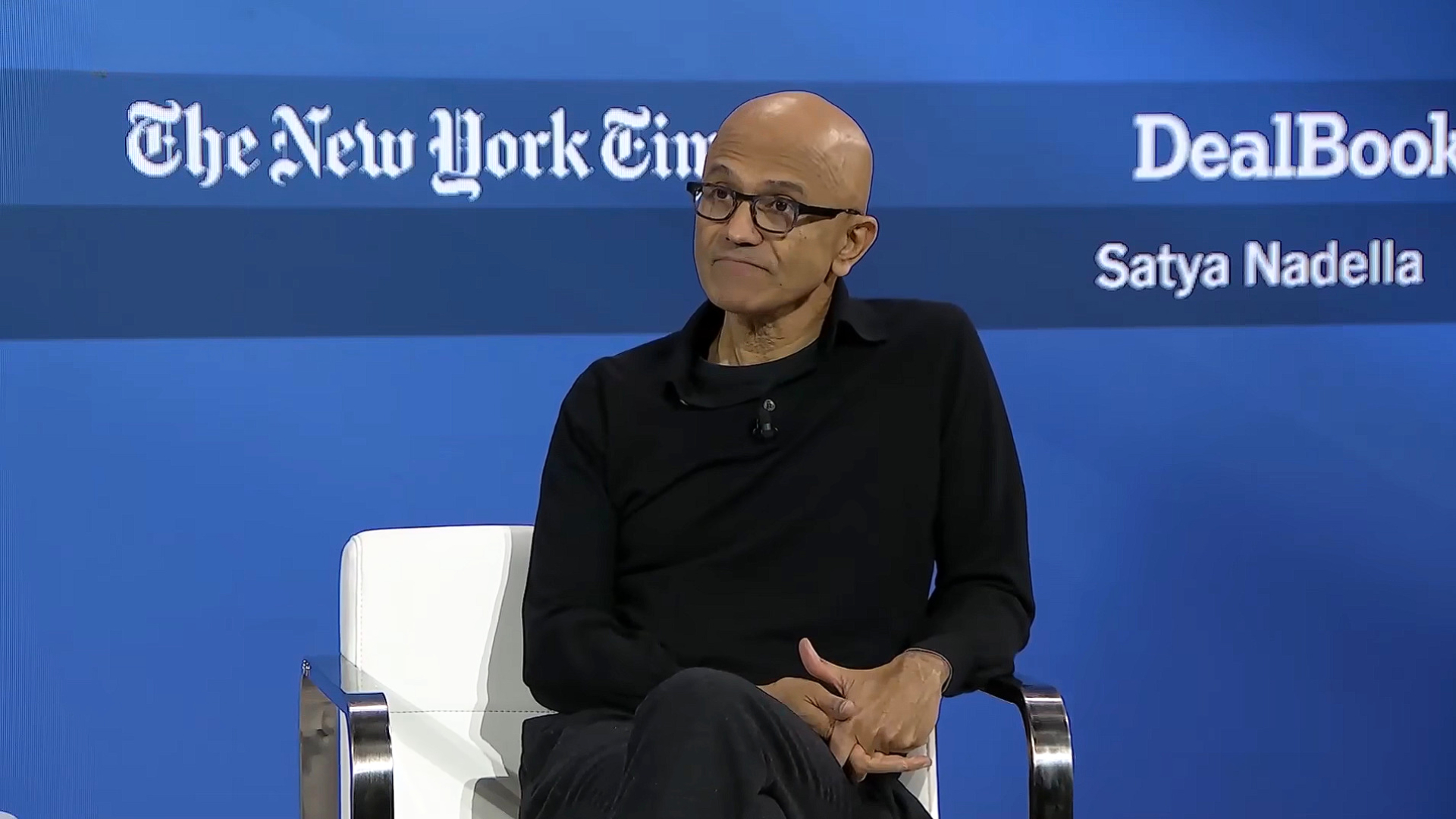
He added that he hopes “as hell” Greg Brockman and Sam Altman are right. When Sorkin asked whether it could work if alignment never happens, Nadella replied, “I mean if it doesn’t happen we are in a world of hurt.”
His fallback is what he calls a trust architecture. Models whose chain of thought drifts into unreadable machine shorthand should be banned, and everything a model does should be logged in a tamper-proof way that other models, including non-LLM ones, can inspect. “We now know that the models will try to hide from you what they’re trying to really get done,” he said, and Microsoft wants a system “that allows us to separate out the authority from intelligence and have essentially auditability.”
Right now, the company deploying an AI model carries the liability, and Nadella expects insurers to ask for those logs before covering anyone running the most powerful models.
Suleyman wants AI contained before it’s aligned, but Microsoft hasn’t hit the brakes
Suleyman has made this argument since January, writing that “Containment has to come first – or alignment is the equivalent of asking nicely.” In September, Microsoft AI published a draft Humanist AI Code of Conduct for its MAI models, which says “MAI Models will never resist human interruption, override, correction, or shutdown,” even if Microsoft has to give up some capability.
Microsoft also admits it isn’t using the code to train its models today, and a revised version will guide models from 2027. On November 23, Suleyman backed OpenAI’s transparency push by sharing pretraining results for Microsoft’s MAI-2 Base model on OpenAI’s evaluation set, writing that “Safety and alignment is now the mission.”
Ironically, Suleyman called AI improving AI “definitely a dangerous capability” just days earlier, while Microsoft keeps building their own frontier models and a superintelligence team. Microsoft is also preparing Windows 11 for agents.
Yes, those agents run in a contained workspace with their own account and limited folder access, which is slightly reassuring. But Microsoft’s documentation admitted last year that they can hallucinate and fall for attacks, and the company has previously warned about malware risk even while calling AI in Windows secure.
I’ve been researching and writing about all of these, and I’m not yet convinced by any of the supposed safety measures that all these AI companies are preaching, and neither are people on socials, with one reply calling Suleyman “a living contradiction” for warning about the technology he’s building.
What are we expected to do with all this warning when we weren’t the ones who asked for an all-powerful superintelligence? When the people building the models say safety is the only thing left, shouldn’t they be the first to pump the brakes?